
Every day, thousands of motorists across the Dayton metropolitan area pull up to local service stations, insert their credit cards, and pump gallons of fuel into their vehicles. As the digital numbers on the fuel dispenser spin alongside the escalating price, consumers rarely stop to question the mechanical precision of the transaction. We inherently trust that a single gallon displayed on the digital screen matches exactly one standard volumetric gallon delivered into our fuel tanks. This precision is not an honor system maintained by corporate petroleum brands. Under the regulatory landscape of the state of Ohio, fuel delivery systems are subject to strict legal testing and field calibration protocols. This essential consumer protection framework is executed by a specialized local enforcement division operating beneath the public radar. This definitive guide unpacks the mechanics of Montgomery County weights and measures audits, outlines the security tracking behind an Ohio gas pump inspection seal, and details how citizens can systematically identify and report short measure gas station Dayton operators.
The Statutory Role of the Montgomery County Auditor in Consumer Protection
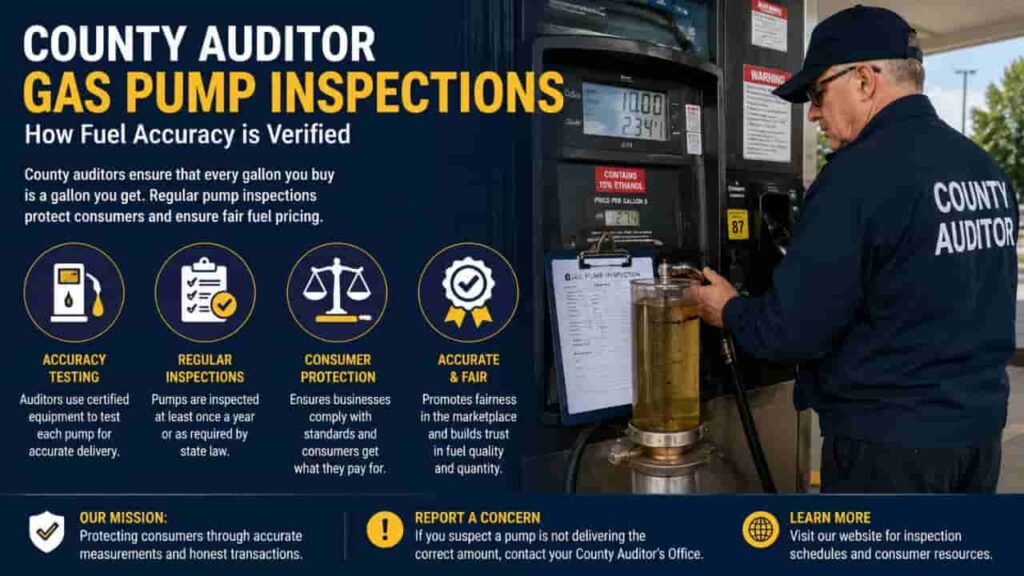
Under the Ohio Revised Code, the County Auditor is officially designated as the Sealer of Weights and Measures for their respective county. This mandate transforms the Auditor from a standard property tax accountant into the front line regulatory guardian of local economic equity. Whenever a transaction involves purchasing an asset by weight, measure, count, or volume, the Auditor’s specialized field enforcement team possesses absolute statutory authority to test, calibrate, or condemn the commercial equipment involved. The Auditor directly protects the economic interests of local motorists through several vital administrative structures.
- Executes Unannounced Field Audits.
Inspectors arrive at local gas stations without prior warning, instantly taking control of random fuel lanes to verify mechanical accuracy before operators can manually adjust pump computer codes. - Deploys Certified Volumetric Provers.
The Auditor maintains specialized testing vehicles equipped with certified five gallon copper testing vessels, calibrated precisely against the National Institute of Standards and Technology (NIST) baselines. - Enforces Financial Equity Standards.
By ensuring that a standard legal gallon is delivered for every gallon billed, the Auditor eliminates commercial retail fraud and maintains a level playing field for honest corporate gas station operators.
The Technical Field Audit, How Inspectors Verify Every Single Drop
The execution of a county auditor scale testing track or a volumetric gas pump verification involves an analytical, multi phase technical inspection strategy. Field teams do not simply look at a machine’s digital screen. They execute physical fluid dynamics testing to capture real time mechanical variances across varying flow rates. The three column table below outlines the core components evaluated by inspectors during an official field audit.
| Technical Audit Component | Objective Field Testing Methodology | Impact on Consumer Financial Accuracy |
| Fast Flow Volumetric Delivery | The inspector pumps fuel into a calibrated five gallon prover at maximum nozzle velocity, simulating a standard consumer vehicle fill up. | Verifies that high fluid pressure within the underground piping systems does not cause digital meter tracking errors on the dispenser head. |
| Slow Flow Mechanical Check | The inspector triggers a secondary five gallon delivery at the lowest possible flow velocity, checking for slow leaks or internal fuel bypasses. | Prevents dispensing systems from under delivering fuel during the final staging of a transaction when a user slows down the manual lever. |
| Total Price Per Gallon Sync | The auditing team cross references the digital price per gallon multiplier against the absolute final mathematical price calculation on the receipt ledger. | Eliminates digital electronic programming glitches or illegal firmware configurations that could quietly overcharge a user by fractions of a cent per gallon. |
Decoding the Visual Defense, The Ohio Gas Pump Inspection Seal
The most prominent visual indicator of a successful consumer protection audit is a specialized sticker placed directly onto the external casing of the fueling unit. Once an inspector confirms that a pump’s internal delivery metrics fall within the strict tolerance parameters allowed by state law (typically within a minor variance of just a few cubic inches per five gallons), they apply the official Ohio gas pump inspection seal.
This specialized adhesive banner displays the specific calendar year of the audit, the official emblem of the Montgomery County Auditor, and a designated tracking serial code. If a pump fails the evaluation by under delivering fuel or demonstrating faulty pricing logic, the inspector will apply a bright red “Condemned” sticker over the system, locking out the internal nozzle mechanism. Under strict state criminal statutes, tampering with, breaking, or counterfeiting an official validation seal carries severe misdemeanor or felony penalties.
Step by Step Guide for Motorists to Identify and Report Fuel Inaccuracies
If you suspect that a local filling station is delivering short measures or utilizing deceptive digital interfaces, you must act methodically to report the violation. Follow this professional step by step framework to launch an official administrative investigation.
Step 1. Document the Complete Transaction Geometry
The moment you observe a calculation error or a mechanical glitch such as the digital meter charging you money before you squeeze the hand nozzle stop the transaction. Take a clear photograph of the pump face showing the exact gallons delivered, the price per gallon, and the final dollar total. Note the specific fuel grade (Regular, Mid grade, Premium, or Diesel) and write down the exact pump lane number.
Step 2. Locate the County Validation Sticker
Walk around the device and find the official county inspection sticker. Note the year printed on the emblem and write down any visible inspector initials or serial numbers. This data helps the real estate and weights department determine if a pump has gone too long without a routine inspection check.
Step 3. Secure Your Financial Transaction Receipt
Always print a physical paper receipt at the pump terminal or request one directly from the station cashier. The printed receipt serves as legal proof of purchase, documenting the timestamp, station address, corporate brand name, and the specific credit card transaction tracking metadata.
Step 4. Submit a Formal Complaint to the Auditor’s Enforcement Office
Go to the consumer protection portal hosted by the Montgomery County Auditor or call the dedicated weights and measures hotline directly. Submit your logged transaction details, photographs, and the station’s physical location. The Auditor’s office treats short measure complaints with maximum urgency, typically dispatching a field inspector to the target station within twenty four to forty eight hours to execute an unannounced code validation audit.
Conclusion
The consumer verification systems managed by the Montgomery County weights and measures division are essential to preserving financial equity at the fuel pump. By understanding the rigorous testing methods, tracking the placement of the official Ohio gas pump inspection seal, and knowing the exact steps to report short measure discrepancies, local citizens can actively participate in protecting the community marketplace. The County Auditor remains your primary ally in ensuring that every dollar spent at a Dayton gas station translates into accurate fuel delivery. Keep this consumer guide handy to keep your vehicle transactions secure, accurate, and completely compliant with state legal standards.
FAQs
What should I do if a gas pump charges me before fuel is dispensed?
Stop the transaction immediately, print your receipt, take a photo of the pump screen, and submit an official short measure complaint to the Auditor’s office.
How often does the Auditor test gas pumps in Montgomery County?
Inspectors execute exhaustive, unannounced volumetric tests at every licensed commercial service station within the county boundaries at least once per calendar year.
What does a red sticker on a gas pump mean in Ohio?
A red sticker indicates the pump failed inspection accuracy tolerances and is legally condemned. The station cannot operate that pump until it is mechanically repaired and re tested.
Can a station owner adjust pump calibrations after an inspector leaves?
No. Inspectors place secure physical lead seals on the internal mechanical calibration adjustments, making unauthorized adjustments a severe violation of state law.
Who should I contact to report an inaccurate grocery store food scale?
The same weights and measures division handles grocery scales. You can file a scale accuracy report directly through the Auditor’s standard consumer complaint portal.