For owners, buyers, and transport contractors of manufactured and mobile homes within the Dayton metropolitan area, executing a physical structural move involves unique legal hurdles. Unlike traditional brick and mortar real estate, manufactured housing occupies a specialized hybrid space under Ohio law. They are built on mobile chassis systems but taxed as structures, meaning they cannot be hooked up to a towing vehicle and driven down public highways on a whim. To legally transport a manufactured structure across local roads, the state mandates absolute tax clearance and formal administrative approval prior to the hookup. Moving a home without verifying its public record status can lead to costly delays at highway state highway patrol checkpoints, hefty civil fines, and the mechanical impoundment of the transport rig. This definitive operational guide outlines the step by step process to secure a Montgomery County mobile home relocation permit, details the submission of county auditor transfer form DTE 100M, and explains how to obtain a certified mobile home tax certificate.
The Statutory Role of the Montgomery County Auditor in Manufactured Housing Compliance
Under the Ohio Revised Code, the County Auditor serves as the primary supervisor, tax assessor, and title clearinghouse for all manufactured housing assets operating within county lines. While the Ohio Bureau of Motor Vehicles (BMV) manages the physical paper titles for these structures, it is the local Auditor’s manufactured housing division that controls the tax assessment duplicates and issues mandatory transit decals. The Auditor directly supports mobile home owners and ensures legal compliance through several core administrative responsibilities.
- Verifies Up to Date Tax Ledgers.
The Auditor thoroughly checks the parcel accounts to guarantee that all current and delinquent manufactured home taxes are paid in full before an asset is cleared for transit. - Processes Real Estate Status Conversions.
If an owner decides to permanently attach a manufactured home to a fixed foundation on their own land, the Auditor processes the paperwork to convert it from a chattel asset to traditional taxable real property. - Issues Mandatory Moving Decals.
The Auditor generates the official physical relocation permits and bright green or yellow window stickers required by law to be displayed during transit.
Demystifying Ohio Manufactured Housing Forms and Documentation
Understanding the paperwork pathways required for moving a manufactured home Ohio transport teams recognize requires managing highly specialized tax forms. Failing to submit the correct variant can freeze your transit timelines indefinitely. The three column comparison table below breaks down the primary regulatory documents managed by the Auditor’s office.
| Required Ohio Tax Form | Official Statutory Definition & Purpose | Impact on Your Transport and Relocation Process |
| County Auditor Transfer Form DTE 100M | The formal application used to declare a change of ownership or a physical relocation of a manufactured home. | Mandatory First Step. Must be filled out by the current owner to trigger the Auditor’s tax duplicate review. |
| Mobile Home Tax Certificate | A certified ledger stamped by the County Treasurer confirming that all property taxes are paid up to date. | Closing Prerequisite. Serves as the official legal green light required before a relocation permit can be generated. |
| Relocation Permit Decal | A high visibility, dated physical sticker that must be displayed prominently on the rear of the structure during transit. | Highway Protection. Proves to local police and state highway patrol units that the move has been fully audited and authorized. |
Step by Step Guide to Securing Your Mobile Home Relocation Permit
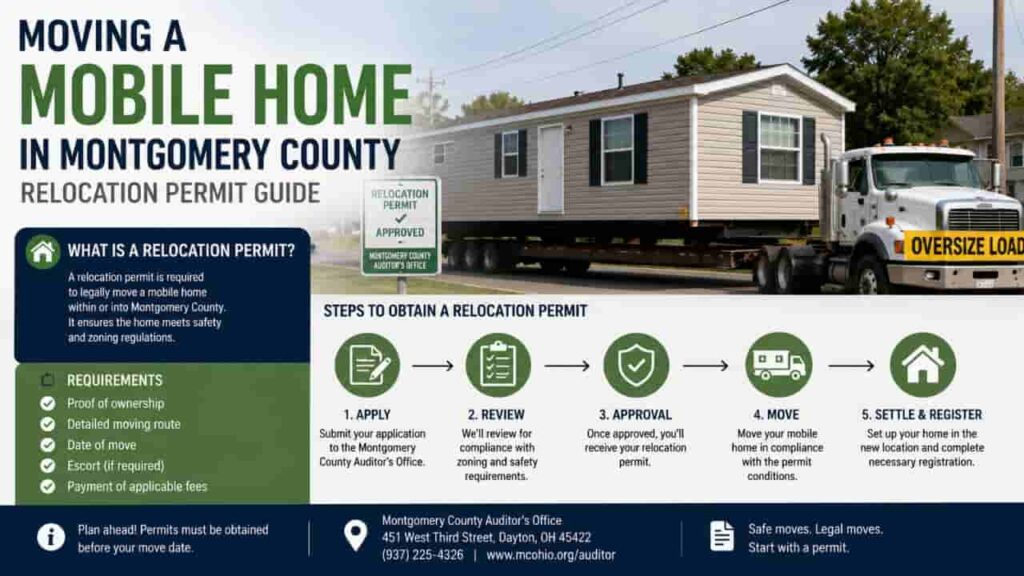
To secure your moving credentials without facing administrative delays or roadside law enforcement issues, you must follow this systematic, step by step roadmap.
Step 1. Gather the Current Vehicle Title and Identification Numbers
Before initiating any public document queries, locate the original physical vehicle title issued by the Ohio BMV. Write down the precise vehicle identification number (VIN), the manufacturer name, the model year, the exact structural dimensions, and the unique multi digit tax parcel number assigned to the home by the county.
Step 2. Query the Parcel Profile and Check for Outstanding Back Taxes
Go to the real estate and manufactured housing search portal hosted by the Montgomery County Auditor. Input your parcel identifier to review the active tax duplicate. You must ensure that all historical taxes, current billing cycles, and any accumulated late payment interest penalties are paid down to a balance of absolute zero.
Step 3. Complete and Submit County Auditor Transfer Form DTE 100M
Download county auditor transfer form DTE 100M (Statement of Reason for Exemption from Manufactured Home Transfer Request) or the standard DTE 100M transfer application from the county portal. Complete all sections carefully, clearly identifying the current owner, the prospective buyer (if applicable), the current physical address of the home, and the exact physical address of the destination park or land parcel.
Step 4. Secure the Stamped Mobile Home Tax Certificate
Take your completed DTE 100M form to the County Treasurer’s office to secure your official mobile home tax certificate. If taxes are clear, the Treasurer will stamp the document. Return this stamped certificate to the Auditor’s manufactured housing desk. Pay the statutory five dollar ($5) relocation permit fee. The Auditor will then print your physical Relocation Permit along with a high visibility transit decal.
Step 5. Affix the Permit Decal and Execute the Move Legally
Deliver the printed relocation documents to your licensed and insured manufactured housing transport company. Before the truck moves the structure onto public Dayton roadways, affix the physical transit decal firmly to the rear exterior of the mobile home, ensuring it remains fully visible to following traffic and law enforcement throughout the relocation journey.
The Financial Risk of Unpermitted Moves, Strict Statutory Penalties
An essential operational rule that all mobile home buyers, park managers, and transport companies must remember is the severity of the penalties enforced for moving a structure without a permit. Under Ohio statutory law, executing an unpermitted move or failing to display the official transit decal carries an automatic, mandatory civil penalty of one hundred dollars ($100) charged directly against the property owner.
Furthermore, local law enforcement or the Ohio State Highway Patrol can instantly pull over the transport rig, issue moving violations to the driver, and order the entire setup grounded at the roadside until the appropriate tax clearances are manually performed at the Auditor’s office. Taking the time to secure your Montgomery County mobile home relocation permit ahead of schedule eliminates these severe operational disruptions completely.
Conclusion
Obtaining a formal Montgomery County mobile home relocation permit is a mandatory legal prerequisite for safely and successfully moving a manufactured home in the Dayton area. By working alongside the tracking frameworks managed by the County Auditor and properly executing county auditor transfer form DTE 100M, you can easily resolve tax liabilities and clear your title for transit. Staying informed on these specialized mobile housing rules safeguards your investments and keeps your transport operations completely aligned with state law.
FAQs
Why do I need a relocation permit to move my mobile home?
Ohio law requires a permit to guarantee that all past and current property taxes are fully paid before a manufactured home can be removed from the county.
Where do I get county auditor transfer form DTE 100M?
You can download Form DTE 100M directly from the official forms repository on the Montgomery County Auditor’s website or pick it up in downtown Dayton.
What is the penalty for moving a manufactured home without a permit?
Moving a home without a permit triggers an automatic one hundred dollar fine and allows law enforcement to ground your transport vehicle mid transit.
How long is a Montgomery County mobile home relocation permit valid?
Once issued by the Auditor’s office, a relocation permit is valid for a strict statutory window of thirty days from the official date of issuance.
Can I get a permit if I owe delinquent mobile home taxes?
No. The County Treasurer will not stamp your tax certificate until all delinquent balances and interest fees are completely paid down to zero.