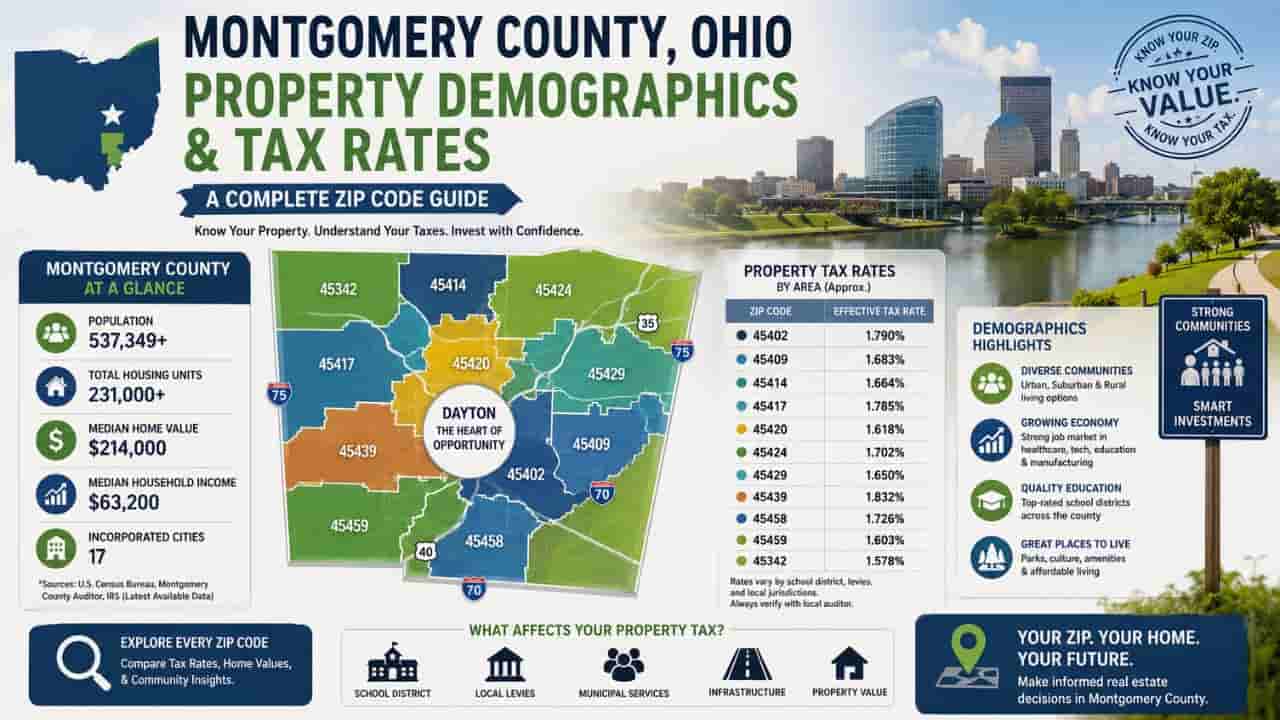
When researching real estate data on the official County Auditor portal (mcrealestate.org), savvy buyers and homeowners look past the listing price. True homeownership costs in the Miami Valley, spanning Dayton, Kettering, Centerville, and Oakwood are deeply tied to property tax calculations handled directly by the County Auditor’s office. Because property taxes in Southwest Ohio fluctuate significantly based on school district millage rates and the county’s mandatory 2026 Property Reappraisal cycle, a generic home loan estimator will fail you. To plan safely, you need to sync your loan projection with official county metrics. This definitive, step by step structural guide explains how to use a local mortgage calculator to find your exact monthly Principal, Interest, Taxes, and Insurance (PITI) liability.
Montgomery County Mortgage Calculator
Estimate your monthly house payment (PITI) including local Ohio property taxes, home insurance, and interest rates.
Payment Breakdown
Why the Montgomery County Auditor’s Tax Data Controls Your Mortgage
When an institutional mortgage lender reviews your financing application, they assess your total monthly debt to income (DTI) ratio based on your comprehensive housing payment, or PITI. While your principal and interest (P&I) stay fixed based on your bank loan program, the “T” (Taxes) is governed entirely by the Montgomery County Auditor. In Ohio, property taxes are not calculated against 100% of your home’s open market value. Instead, they follow a distinct structural legal methodology under state law.
The Official Ohio Property Tax Formula
- Appraised Value (Market Value). The actual true market value assigned to the real estate by the Auditor during county reappraisals.
- Assessed Taxable Value. Under Ohio Revised Code, your taxable value is exactly 35% of the appraised value. If a home in Dayton is appraised at $200,000, you are only taxed on an assessed value of $70,000.
- Millage Rates. One mill equals $1 of tax for every $1,000 of assessed value. Local school districts, municipal bonds, and township police/fire levies determine the total active mills applied to your parcel.
Step by Step, Projecting Monthly PITI Using a Local Calculator
To calculate an airtight budget before committing to an escrow contract, you must integrate public records data into your calculation workflow. Follow this step by step roadmap to eliminate financial blind spots.
Step 1. Extract the Parcel Value from mcrealestate.org
Locate your target property on the Montgomery County Real Estate portal using the address or unique Parcel ID search. Visit the “Value History” or “Tax Summary” tab to view the current Appraised Market Value.
Step 2. Factor in Regional Millage Differences
Montgomery County’s effective tax rates generally range from 1.58% to over 2.2% depending on the specific neighborhood boundaries. High demand school zones will naturally carry higher millage distributions, increasing the escrow requirement on your monthly loan statement.
Step 3. Combine Structural Fixed Costs
Input your proposed down payment alongside current local interest rates. Ensure your hazard home insurance line item is realistic for Ohio (~$1,200 annually for standard single family properties) to view a clear breakdown of your net closing and monthly operational footprint.
Production Projections, Sample Payments by District
To illustrate how local Auditor metrics shape your house payment, the table below showcases baseline PITI projections using a standard 6.5% interest rate, a 20% down payment injection, and representative effective tax rates across Montgomery County.
Estimated Monthly PITI Cost Breakdown
| Home Appraised Value | Location / Representative Tax Rate | Estimated Total Monthly PITI |
| $175,000 | Dayton City District (1.85%) | $1,272.00 |
| $250,000 | Huber Heights (1.80%) | $1,807.00 |
| $350,000 | Centerville / Washington Twp (1.95%) | $2,574.00 |
| $500,000 | Kettering City District (1.90%) | $3,656.00 |
| $750,000 | Oakwood City District (2.35%) | $5,640.00 |
Pro Tip for Homebuyers. Ohio property taxes are billed in arrears and collected semi annually. Your monthly mortgage statement will typically collect 1/12th of this liability each month, holding it securely in a non interest bearing escrow account until payment is due to the Montgomery County Treasurer in February and July.
Managing Valuation Spikes, The 2026 Property Reappraisal Impact
Every six years, the State of Ohio mandates that the local Auditor re evaluate all real estate parcels to match macro market values. The 2026 Property Reappraisal cycle in Montgomery County is currently adjusting home values across the Miami Valley to align with recent historic real estate appreciations.
How a Reappraisal Alters Your Monthly Mortgage
If the Auditor updates your parcel’s appraised market value upward, your 35% taxable value rises proportionally. For homeowners utilizing an escrowed mortgage, this shift creates a dual financial effect.
- The Escrow Shortage.
Your servicer will discover that the previous year’s monthly collections are insufficient to cover the new, higher tax bill sent by the Treasurer. - Payment Escalation.
To rectify the shortfall, your mortgage company will increase your monthly PITI requirement for the upcoming year to clear the past deficit while budgeting for the higher forward tax liability.
Homeowners who disagree with a structural adjustment have a legal right to submit a formal valuation complaint to the Montgomery County Board of Revision (BOR) between January 1st and March 31st, utilizing verified independent appraisals or repair estimates as evidence.
Conclusion
Accurately predicting housing affordability in the Dayton metro area requires moving beyond generic loan tools and integrating official local metrics. By leveraging the Montgomery County Auditor’s public data infrastructure, applying Ohio’s 35% taxable value framework, and anticipating the impact of localized school district millage rates, you protect your household from unforeseen payment hikes. Run your target numbers through our specialized local calculator tool, cross reference parcel profiles on mcrealestate.org, and consult with a licensed regional finance professional to execute your next real estate transaction with complete operational confidence.
FAQs
Can I use the Auditor’s site to see if a home requires PMI?
No. The Auditor’s portal only tracks public tax assessments and deed records. PMI is strictly an internal mortgage lender requirement triggered if your down payment is below 20%.
How can the Montgomery County Homestead Exemption reduce my monthly mortgage?
If you qualify, it shields up to $26,200 of your home’s value from real estate taxes. This directly lowers your annual tax bill, reducing your monthly mortgage escrow.
Why does my mortgage payment change even with a fixed rate loan program?
Your principal and interest stay the same, but if the Auditor updates your property valuation or local school millage rates increase, your monthly escrow tax obligation will change.
What is the difference between the Montgomery County Auditor and Treasurer?
The Auditor establishes your property’s fair market appraisal and calculates taxable values. The Treasurer takes that final data to issue the actual bills and collect your tax payments.
Should I calculate my monthly tax payment using the purchase price or the Auditor’s valuation?
Use the current Auditor valuation for immediate estimates. However, expect the Auditor to eventually adjust the property’s appraised value closer to your new purchase price over time.