When property owners receive their triennial update or sexennial reappraisal notices from local administrative authorities, many are shocked to find that their home’s assessed value has suddenly spiked. Because real estate values directly dictate annual tax escrow amounts, an inflated market appraisal translates directly into higher monthly overhead. In the Dayton metropolitan area, citizens do not have to accept an inaccurate property assessment as absolute truth. If you believe the county has overvalued your residential or commercial real estate compared to actual marketplace realities, you have a formal statutory right to challenge the data. This definitive guide details the legal mechanics of working through Montgomery County board of revision complaints, provides a step by step roadmap for filing form DTE 1, and outlines the exact evidence frameworks required to successfully lower your market value appraisal Ohio.
The Administrative and Legal Role of the Montgomery County Auditor in the BOR Process
Under the Ohio Revised Code, the Board of Revision (BOR) operates as a quasi judicial administrative body designed specifically to hear formal disputes regarding property valuations. The Board itself is composed of three distinct county officials, the County Treasurer, the President of the County Commission, and the County Auditor. While the Auditor serves as a voting member of this panel, their real estate division also acts as the primary administrative manager for the entire complaint process. The Auditor supports local homeowners and facilitates fair assessment reviews through several core functions.
- Serves as the Official Filing Registry.
The Auditor’s team accepts, logs, and processes all incoming property valuation disputes, assigning unique case tracking numbers to each parcel. - Distributes Mandatory Legal Notifications.
When an owner files an appraisal challenge, the Auditor legally notifies the local school district board, allowing them to participate in the valuation review. - Implements Final Court Ordered Valuation Shifts.
Following a formal BOR decision, the Auditor manually adjusts the county tax duplicate, instantly recalculating the owner’s underlying property tax liabilities.
Building an Irrefutable Evidence Framework to Challenge Your Assessment
The most common mistake local property owners make when filing a complaint is entering a hearing with purely emotional arguments, such as stating that “taxes are simply too high.” The Board of Revision is legally restricted to evaluating one specific metric. The true market value of the property as of the tax lien date (January 1st of the tax year in question). To challenge a data footprint successfully, you must provide clear, objective documentation. The three column table below outlines the primary forms of evidence recognized by the board when you look to contest property value assessment Dayton profiles.
| Recognized Evidence Category | Specific Documentation Requirements | Technical Impact on the Board’s Evaluation |
| Recent Arms Length Sale | A certified copy of the settlement statement (HUD-1 or closing disclosure) showing a recent purchase within the last 24 months. | Highest Weight. An open market purchase between unrelated parties is treated by Ohio courts as the absolute best indicator of true market value. |
| Certified Independent Appraisal | A formal, uniform residential appraisal report prepared by a state licensed, independent real estate appraiser for the target tax lien date. | Strong Weight. Provides an expert structural and neighborhood analysis that counteracts generic automated valuation models used by the county. |
| Severe Structural Damage Reports | Certified repair estimates from licensed contractors, structural engineering reports, or interior photos detailing major active defects. | Moderate to High Weight. Proves the interior or foundation of the asset has suffered physical deterioration not accounted for by the Auditor’s exterior imagery. |
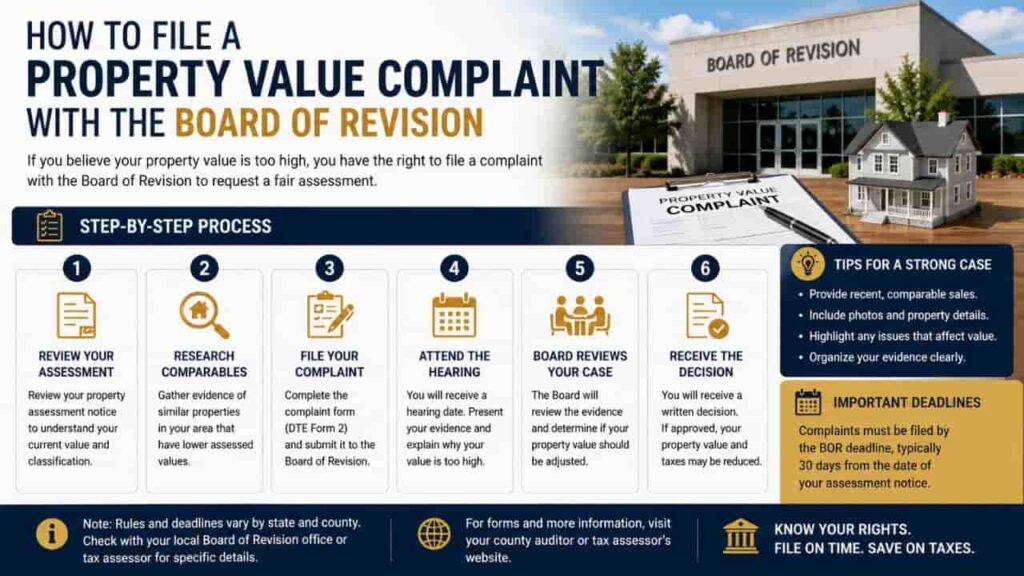
Step by Step Guide to Filing Form DTE 1 and Attending Your Hearing
To successfully contest your real estate footprint without facing quick administrative dismissals, you must execute your filings according to strict state deadlines and legal protocols.
Step 1. Download and Complete Official Form DTE 1
Obtain Form DTE 1 (Complaint Against the Valuation of Real Property) directly from the Montgomery County Auditor’s web portal. Complete all fields accurately, including the exact multi digit parcel identification number (PIN), current owner contact data, and your specific opinion of the property’s true market value.
Step 2. Observe the Strict Statutory Filing Windows
Under Ohio statutory frameworks, the filing window for property valuation complaints opens on January 1st and closes firmly on March 31st of each calendar year. Applications postmarked or digitally transmitted after midnight on March 31st are automatically rejected by law, forcing the owner to wait an entire year before filing another challenge.
Step 3. Compile and Cross Reference Your Comparative Sales Data
If you have not recently purchased the home or had it appraised, locate three nearby properties that match your home’s structural footprint, square footage, and age, and that sold on the open market within the past 24 months. Print these sales summaries directly from the Auditor’s public real estate dashboard to serve as supplemental exhibits.
Step 4. Present Your Case Before the Three Member Board
Once your form is reviewed, the Auditor will mail you an official notification detailing your assigned hearing date and time. At the hearing, present your factual evidence calmly to the board members. Focus entirely on physical property conditions, neighborhood comps, and documented market values rather than general complaints about tax rates.
Step 5. Await the Final Determination and Escrow Adjustment
Following your public testimony, the board will deliberate and issue a formal written decision via certified mail within several weeks. If the board approves a value reduction, the Auditor’s office will update the property tax records, apply any necessary tax credits to your account, and notify your mortgage lender to re calculate your monthly escrow payments.
The Statutory “One Strike” Limitation Rule for Tax Filings
An essential operational detail that all local real estate investors and homeowners must remember is the strict “once every three years” limitation rule enforced by the state of Ohio. Under current state statutes, a property owner is legally permitted to file only one valuation complaint with the Board of Revision during a single triennial interim period.
If you file a complaint and receive a ruling, you cannot file another challenge the following year simply because market trends alter. The only exceptions that bypass this limitation are if the property has undergone an absolute physical change (such as a total building demolition or a devastating fire), or if the property was sold in a completely new, verified arms length transaction. This structural rule makes compiling high quality evidence during your initial submission critical.
Conclusion
Filing a formal Montgomery County board of revision complaints track is a powerful legal pathway for homeowners and investors to regain control over inaccurate real estate assessments. By methodically organizing authentic documentation, utilizing official online resources provided by the County Auditor, and submitting filing form DTE 1 before the firm March 31st statutory deadline, you can ensure your annual tax obligations reflect true market realities. Use this professional guide to confidently approach the Board of Revision and protect your local property investments from excessive valuation inflation.
FAQs
What is the deadline to file a property value complaint in Montgomery County?
The legal filing window closes firmly on March 31st of each calendar year. Late submissions are automatically dismissed under strict Ohio statutory guidelines.
Can I use my neighbor’s high tax bill as evidence at my hearing?
No. The board only evaluates the objective market value of your specific parcel using certified appraisals, recent sales data, or documented structural damage.
How often can I file a valuation complaint with the Board of Revision?
Ohio law restricts owners to filing one complaint every three years within a triennial tax cycle, unless a specific statutory exception applies.
Do I need to hire an attorney to represent me at the BOR?
No. Individual homeowners can legally present their own cases and evidence, though corporate entities or complex commercial cases often utilize legal counsel.
Will filing a complaint cause the county to increase my home’s value?
While rare, if a local school district files a counter complaint showing your property recently sold for much higher, the board can legally increase the valuation.