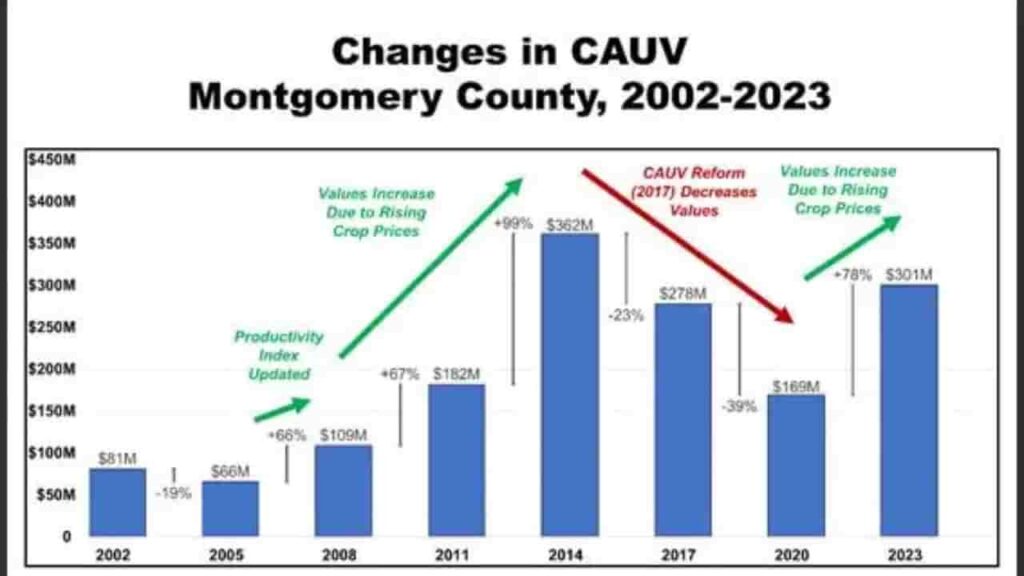
For landowners, commercial farmers, and timber growers operating across the rural and suburban corridors of the Dayton metro region, real estate overhead can quickly strain operational profit margins. If agricultural land were assessed solely on its commercial development value or urban residential potential, escalating market pressures would make farming financially unsustainable. To safeguard local agribusiness and preserve natural open spaces, the state of Ohio utilizes a specialized statutory tax relief mechanism known as the Current Agricultural Use Value (CAUV) program. This constitutional tax framework alters how farmland is appraised, matching tax liabilities directly with actual crop production and soil profiles rather than market speculation. This definitive guide details how to understand the Montgomery County CAUV program, unpacks the hidden savings formulas, and outlines the precise agricultural property tax reduction Dayton qualification criteria.
The Regulatory Role of the Montgomery County Auditor in Managing the CAUV System
In the state of Ohio, the County Auditor serves as the supreme administrative agent responsible for implementing, reviewing, and enforcing the CAUV program parameters within local boundaries. The Auditor’s specialized agricultural appraisal unit does not look at real estate supply and demand or recent neighborhood sales comps to value CAUV land. Instead, they act as data analytical investigators who review official soil topology maps and crop capitalization indexes provided by the state. The Auditor assists local agricultural producers through several vital programmatic functions.
- Applies Scientific Soil Value Indexing. The Auditor tracks the exact distribution of individual soil types across a parcel, matching them with state mandated production baselines.
- Processes Annual Re Certifications. To ensure compliance and prevent commercial land speculation, the Auditor coordinates the legal renewal workflows required to maintain active tax exemptions.
- Manages Statutory Recoupment Audits. If land changes use or fails to maintain agricultural production, the Auditor calculates and collects mandatory financial penalties to protect county tax revenues.
Strict Eligibility Criteria for CAUV Qualification
Securing a substantial agricultural property tax reduction Dayton requires meeting precise, non negotiable statutory requirements under Ohio law. Landowners cannot simply clear a backyard plot and claim an agricultural tax classification. The land must function as a legitimate commercial farming operation. The baseline requirements involve structural acreage minimums or explicit financial milestones.
1. The Total Acreage Threshold
The parcel, or a combination of contiguous agricultural tracts under identical ownership, must consist of a minimum of ten (10) individual acres completely dedicated to commercial agricultural production.
2. The Gross Income Threshold (For Small Acreage)
If the total commercial land footprint measures less than ten continuous acres, the owner must provide official accounting proof that the land generated an average gross agricultural income of at least $2,500 over the three preceding consecutive calendar years.
3. Eligible Agricultural Operational Activities
The land must be used actively for approved operations. This includes commercial crop cultivation, commercial timber harvesting, livestock husbandry, apiculture, aquaculture, or participating in certified federal land conservation reserve programs (CRP).
Decoding the CAUV Savings and Tax Calculation Formula
The unique mechanism behind the current agricultural use value Ohio framework lies in its departure from standard market value appraisals. A property’s typical tax assessment is based on its True Market Value (what the land would sell for to a developer). In contrast, CAUV assessments isolate the net income capability of the specific soil types present on the property. The three column table below breaks down the technical elements used to determine these specialized valuations.
| Technical Valuation Component | Administrative Definition | Impact on Farmland Tax Calculations |
| Soil Type Classification | The physical mapping of the parcel across 3,500 distinct Ohio soil categories, evaluated by state geographical survey tools. | Highly productive crop soils are assigned higher base operational values, while eroded, sloped, or poorly drained soils receive massive valuation drops. |
| Net Income Capitalization | A rolling five year statutory formula that averages regional crop prices, operational fertilizer costs, and average yield metrics. | Eradicates market speculation spikes, if grain market prices drop or farming material expenses rise, the CAUV valuation automatically decreases. |
| Market Value Spread | The calculated numerical difference between the property’s true market value and its certified agricultural use value baseline. | Represents the untaxed portion of the real estate value, directly driving the final annual property tax discount for the farmer. |
Step by Step Guide to Applying for and Maintaining CAUV Status
Enrolling in the CAUV program requires following a strict administrative path to ensure your tax status shifts smoothly without facing delays or structural rejections from the county real estate division.
Step 1. Secure Your Official Property Documentation
Locate your legal deed description and your most recent Montgomery County property tax statement. Identify the precise parcel numbers and verify that the current owner’s registered entity or individual name matches the county records exactly.
Step 2. Complete and File the Initial Application (Form DTE 109)
Obtain Form DTE 109 from the Montgomery County Auditor’s official download portal or physical Dayton office. Complete the form, listing your specific agricultural activities, total acreage distributions (crop fields, pasturage, woodland), and attach your structural maps. Submit this form between the first Monday in January and prior to the official deadline on the first Monday in March, along with the standard, non refundable one time initialization fee of $25.
Step 3. Complete the Annual CAUV Renewal Application Process
Once accepted, CAUV status is not permanent. Every single calendar year, the landowner must fill out a complimentary CAUV renewal application mailed directly by the Auditor’s office. You must confirm that the agricultural usage has not altered, sign the declaration, and return it to the county before the first Monday in March. Failing to file this renewal form completely wipes out your tax reduction, returning the parcel to full market value taxation.
The Financial Danger of Land Use Conversion and Recoupment Penalties
While the CAUV framework provides immense relief, it carries significant legal obligations. If a landowner decides to stop farming and sells the property to a commercial developer to construct a housing subdivision or a shopping plaza, a statutory event called a “Failure to Qualify” occurs.
When the land is converted away from commercial agriculture, the Auditor is legally required to execute a recoupment audit. The county collects a financial tax penalty equal to the exact tax savings enjoyed by the owner during the three preceding tax years. This ensures that the program benefits long term agricultural producers rather than real estate developers looking for temporary tax shelters.
Conclusion
The Montgomery County CAUV program remains a powerful legal financial tool for sustaining local agricultural industries and protecting open timberlands throughout Dayton, Ohio. By understanding the strict acreage thresholds, soil indexing systems, and necessary filing deadlines managed by the County Auditor, you can maximize your tax savings. Maintaining your documentation and submitting your mandatory annual renewal forms ensures your farm stays protected under this official statutory tax reduction framework. Use this professional guide to safeguard your agricultural investments and streamline your county real estate compliance.
FAQs
Does timberland qualify for the Montgomery County CAUV program?
Yes. Commercial timber production and structural woodlots qualify for the tax reduction, provided they meet the minimum acreage thresholds or commercial income guidelines.
What happens if I miss the annual CAUV renewal application deadline?
Missing the first Monday in March deadline automatically cancels your agricultural status. The Auditor will restore your land to its full, expensive market value tax rate.
What is a CAUV recoupment penalty under Ohio real estate law?
If CAUV land is converted to residential or commercial development, the Auditor collects a penalty equal to the past three years of tax savings.
Can I lease my land to a tenant farmer and still receive CAUV benefits?
Yes. The land itself must be used for commercial agriculture. It does not matter if the property owner or a leasing tenant farmer manages the crops.
Is there an annual fee to renew my agricultural tax reduction?
No. The initial registration application requires a one time twenty five dollar fee, but the mandatory annual compliance renewals are entirely free to file.