When real estate owners fall significantly behind on their local public financial liabilities, the administrative process moves past basic collection letters. In the Dayton metro area, unresolved property tax debt eventually triggers a transition from standard delinquency tracking to judicial enforcement. For distressed homeowners, understanding this transition is vital to preventing an absolute loss of real estate equity. Concurrently, for real estate acquisition specialists and institutional investors, these legal proceedings present unique avenues to acquire property portfolios through open public bidding. Working with these public liquidation platforms requires a firm grasp of state legal codes and administrative mechanics. This authoritative guide details the mechanics of a Montgomery County tax lien sale, outlines the operational structures of property tax foreclosure Dayton Ohio, and details the step by step process for analyzing the county auditor tax auction list.
The Administrative Role of the Montgomery County Auditor in Tax Auctions and Foreclosures
While the final physical execution of a property liquidation is managed by the County Sheriff, the entire foundational data layout relies on the Montgomery County Auditor. Under Ohio statutory guidelines, the Auditor acts as the primary financial bookkeeper and tax assessment inspector. The Auditor’s real estate and delinquent tax divisions work alongside the County Treasurer to manage the administrative parameters that dictate which assets face legal liquidation. The Auditor supports the public and helps real estate buyers through several core structural functions.
- Certifies Delinquent Tax Abstracts. The Auditor officially calculates the total accumulated tax shortfalls, interest penalties, and civil administrative fees to determine the exact minimum opening bid baselines.
- Compiles the Statutory Forfeited Land Lists. If a property fails to sell at initial judicial sales, the title is formally forfeited to the state, and the Auditor takes direct control of organizing its future public disposal.
- Adjusts County Land Tax Rolls. Following a successful public auction execution, the Auditor instantly clears out past tax balances, restructures the parcel indexing, and logs the new buyer’s deed information.
Understanding the Operational Framework, Tax Lien Sales vs. Foreclosure Auctions
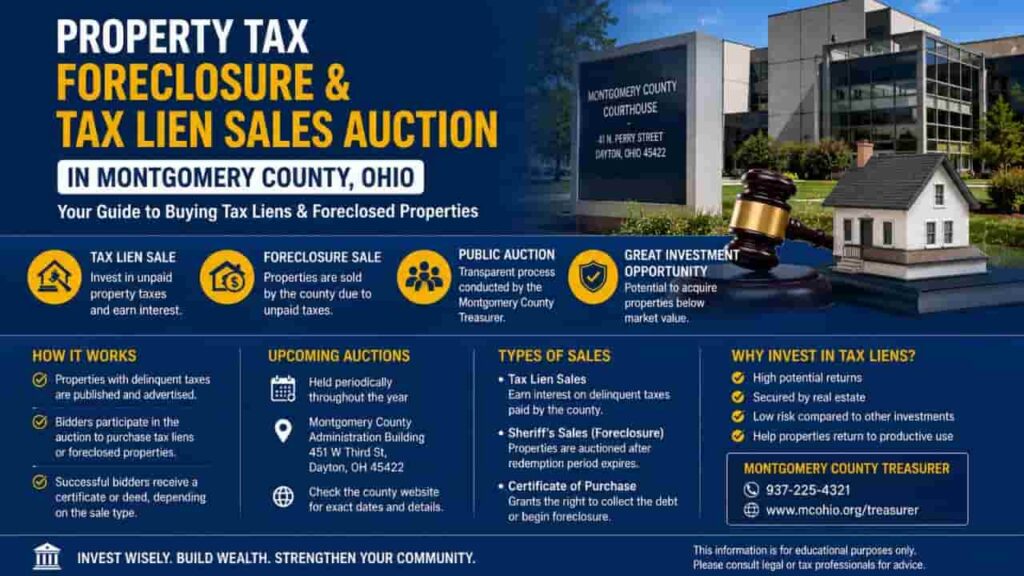
Many investors and property owners confuse the different legal mechanisms used to clear outstanding tax liabilities in Ohio. The county utilizes distinct administrative tracks depending on whether they are selling the absolute real estate title or selling a financial debt certificate. The three column table below breaks down the technical differences found when looking into buying tax foreclosed properties.
| Auction System Type | Official Administrative Mechanism | Investor Risk and Operational Reward |
| Judicial Tax Foreclosure Sale | The County Prosecutor files a civil lawsuit against the owner, leading to a court order that directs the Sheriff to sell the physical real estate at auction. | High Reward. The successful high bidder receives a clean legal title to the property, effectively wiping out old mortgage liens and tax debts. |
| Tax Lien Certificate Sale | The County Treasurer sells a bulk package of delinquent tax debt certificates to private institutional buyers rather than auctioning the physical land. | Moderate Risk. The buyer purchases a first priority financial lien that earns high statutory interest, with the option to foreclose if the owner fails to pay. |
| Forfeited Land Public Auction | Properties that do not receive bids during two separate consecutive Sheriff foreclosure sales are officially transferred directly to the state’s inventory. | Variable Quality. The opening bids are lower, but the physical structures often require significant architectural rehabilitation or structural updates. |
Step by Step Bidding Process for Real Estate Investors
Participating in a public property tax foreclosure Dayton Ohio auction requires strict adherence to institutional operational guidelines. This step by step breakdown explains how to work through the local bidding process from initial research to deed recording.
Step 1. Monitor the Official Public Notice Portals
To locate available inventory, review the legally mandated publications in local newspapers or access the digital county auditor tax auction list directly through the county’s public real estate web dashboards. Write down the precise multi digit parcel identification numbers (PIN) for your target properties.
Step 2. Execute Strict Due Diligence and Structural Screening
Before placing a single dollar at risk, input the parcel numbers into the standard property search platform. Analyze the residential structural cards to review construction grades, layout sizes, and effective years. Always check the physical location of the asset from the street curb. Properties sold at tax auctions are sold entirely “as is,” and internal walk through inspections are legally prohibited.
Step 3. Register for the Public Electronic Auction Platform
In accordance with modern Ohio judicial frameworks, the majority of tax foreclosure sales are conducted via private online auction portals managed by official third party contractors. Complete your user registration profile, upload your identification documents, and verify your account status several business days before the scheduled bidding starts.
Step 4. Meet the Capital Deposit Requirements
To qualify as an active bidder, you must submit a pre determined financial deposit via electronic bank wire or a certified cashier’s check. If you win the auction, the opening deposit is applied directly to your purchase price, if you lose the bidding, the funds are returned entirely to your account.
Step 5. Finalize the Purchase and Record the Transfer Deed
If you submit the winning bid, the closing team will provide a specific deadline (typically within 30 days) to submit the remaining financial balance. Once your payment clears, the county processes the paperwork, clears out the old tax balances, and records a clean deed transferring ownership to your entity.
Right of Redemption Rules for Defending Homeowners
For local property owners facing financial distress, it is vital to know that the county provides clear legal pathways to stop an auction from moving forward. Ohio law includes a safety mechanism known as the “Right of Redemption.”
Up until the exact moment the court officially confirms the final auction sale, the original property owner has the legal right to save their asset. To exercise this option, the owner must pay the entire outstanding balance of back taxes, interest assessments, and county legal fees to the Treasurer. Once this total payment is verified, the foreclosure lawsuit is dismissed, the auction listing is removed, and the owner retains complete title control.
Conclusion
Understanding a Montgomery County tax lien sale or judicial foreclosure requires a precise mix of administrative research, due diligence, and financial discipline. By utilizing the official lists provided by the County Auditor, real estate investors can find valuable market opportunities while minimizing title risks. Concurrently, understanding these timelines allows local homeowners to seek emergency payment options or exercise their right of redemption before an asset is liquidated. Keep this expert transactional guide handy to ensure your auction strategies match the official legal guidelines used across Ohio.
FAQs
Where do I find the official county auditor tax auction list?
The list is published periodically on the Montgomery County Auditor’s real estate website and inside localized legal newspapers before scheduled public foreclosure sales.
Can I inspect the inside of a tax foreclosed home before bidding?
No. All properties sold at tax foreclosure auctions are sold strictly “as is” without internal physical access. Bidders must evaluate properties from the public right of way.
What happens to existing mortgages during a judicial tax foreclosure sale?
A successful judicial tax foreclosure sale completely wipes out standard junior liens, including older private mortgages, ensuring the winning bidder receives a clean title.
How long does a homeowner have to redeem their property from foreclosure?
The original owner can redeem the property anytime before the court officially files the final entry confirming the auction sale with the county.
Do tax lien certificates grant instant physical ownership of the property?
No. Buying a tax lien certificate only transfers ownership of the tax debt. The investor must complete a separate foreclosure process to claim the physical title.