
The property assessment process in Montgomery County determines the taxable value of real estate for homeowners, businesses, and land owners. Every parcel in the county is evaluated to ensure that taxes are assigned fairly based on current market conditions and individual property characteristics. Accurate assessment values help support schools, emergency services, and local government programs funded through property taxes. Understanding how the process works gives owners a clearer picture of how tax amounts are calculated and why values may change over time.
Purpose of Property Assessment in Montgomery County
Property assessment exists to measure the true market value of land and buildings. Montgomery County uses this value to calculate how much tax a property owner must pay. Without assessments, it would be impossible to distribute tax responsibilities fairly among thousands of property owners.
Assessment also helps the real estate market operate transparently. Buyers, sellers, lenders, and investors often rely on assessor values to understand the worth of a home or commercial building. Although assessments are not the same as private appraisals, they offer an official value benchmark for taxation and public reference.
Role of the Montgomery County Auditor in Property Valuation
The Montgomery County Auditor is responsible for assessing property within the county’s borders. The Auditor’s office reviews property data, updates characteristic records, analyzes sales patterns, and runs mass valuation models based on market trends.
The office maintains property details such as:
- square footage
- land use category
- design and structure type
- neighborhood value
- recent sales records
These details are then used to produce a fair estimated value for taxation. For many properties, the assessment process is completed without needing an interior inspection, because the system uses verified data collected over time.
How Property Values Are Determined
The county calculates value using a mass appraisal approach. Instead of placing value on each property individually, assessors compare similar homes or buildings to predict a fair market number. The value reflects what the property might sell for under normal conditions.
Assessors consider elements such as:
- property location
- age and condition
- building style
- lot size
- upgrades or additions
- nearby sale prices
Sales ratio studies help keep neighborhood values consistent. If local home sales rise or fall dramatically, the county adjusts assessment values to match the market direction.
Data Collection and Verification Steps
Before values are changed, the Auditor’s office confirms physical characteristics through field reviews, permit tracking, and aerial imagery. When owners build additions, garages, decks, or remodel interior space, these improvements are recorded because they affect value.
County records are updated continuously, which helps keep assessment values current. Changes to property structure, land boundaries, or demolition events all appear through county databases.
Reappraisal and Update Cycles
Ohio law requires counties to update assessed property values regularly. Montgomery County completes a full reappraisal every six years, which includes physical review and neighborhood market analysis.
Between reappraisals, a triennial update adjusts values based on recent sales data. This helps keep values balanced with current market conditions. Owners may see increases or decreases depending on where real estate prices are trending.
How Assessments Affect Property Taxes
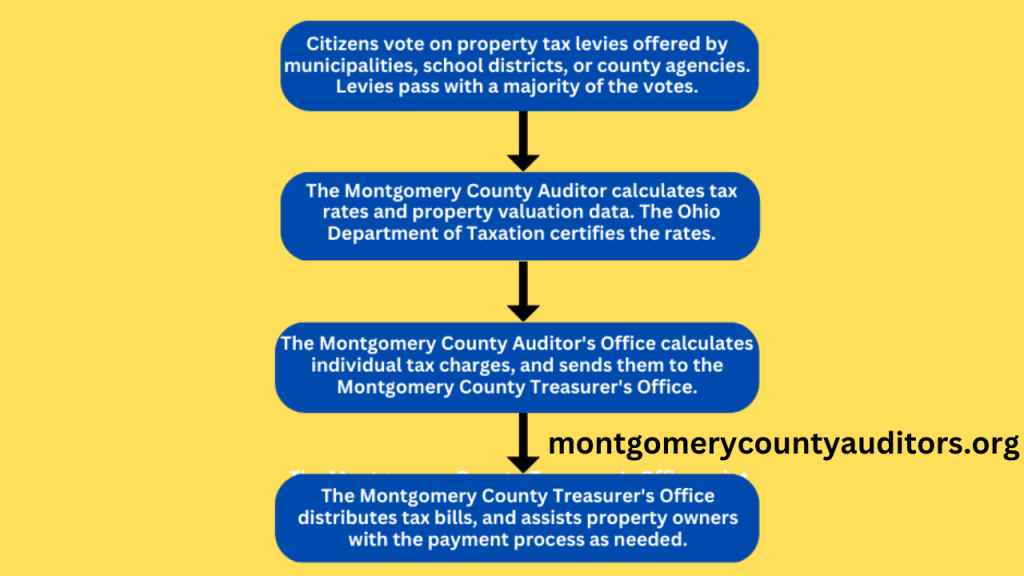
The assessed value is used to calculate the taxes owed on a property. After determining market value, the county applies assessment ratios and local tax rates to produce annual charges.
Higher market values usually result in higher taxes, while declining values may reduce tax amounts. Local levies, school funding, and voter-approved programs also influence the final bill.
Appealing an Assessment Value
Property owners have the right to challenge county values if they believe the assessment is too high. The appeal process involves showing evidence that similar properties are valued lower or presenting proof that the county record is inaccurate.
Supporting documents may include:
- private appraisal results
- recent sale prices
- photographs that show property condition
- square footage corrections
Successful appeals may lead to reduced assessed value and lower tax charges.
Public Transparency and Record Access
The property assessment system is publicly accessible online, allowing owners to check valuation history, property records, tax charges, and neighborhood data. Transparency ensures fair application of tax laws and helps owners understand the reasoning behind value changes.
This access also encourages real estate growth because buyers and sellers can review data without depending on private sources.
Conclusion
The property assessment process in Montgomery County, Ohio, ensures accurate and fair valuation of real estate for taxation purposes. By understanding how the Montgomery County Auditor collects property data, determines assessed values, and conducts periodic reappraisals, homeowners and investors can confidently manage their property taxes. Utilizing the Montgomery County Auditor’s resources for reviewing assessments or filing appeals helps protect your financial interests. Staying informed about Montgomery County property assessments promotes transparency, accuracy, and fairness in local real estate taxation.
Frequently Asked Questions
1. Who assesses property values in Montgomery County?
The Montgomery County Auditor’s office performs assessments and manages valuation updates.
2. How often are property values updated?
A full reappraisal occurs every six years, and a triennial update adjusts values between those cycles.
3. Can assessments change taxes?
Yes, assessed value is directly linked to annual tax charges.
4. What if a homeowner disagrees with the assessed value?
Owners may file an appeal and present evidence to request value review.
5. Does adding new structures raise property value?
Additions such as decks, garages, or rooms may increase assessed value.
- Ohio Property Tax Reform 2026: Impact on Montgomery County Homeowners
- How to Get Cigarette License in Montgomery County, Ohio
- How to Track Court Case Progress in Montgomery County OH
- How to Get a Property Record Copy from Montgomery County Auditor Ohio
- Montgomery County Jail Release & Bond Information Search
